From "searchable" to "answerable" across seven archive types
Content parsing and semantic retrieval on the digital archive of Guangdong Power Grid, turning archive data into extractable, compilable knowledge assets.
Background
The digital archive already solved storage and catalogue search, but archive content stayed a black box: what events and which organisations a yearbook contains still required manual reading.
Compilation long relied on manual transcription; yearbooks, chronicles and milestone records have strict conventions and formats, so output was slow and hard to reuse.
Approach
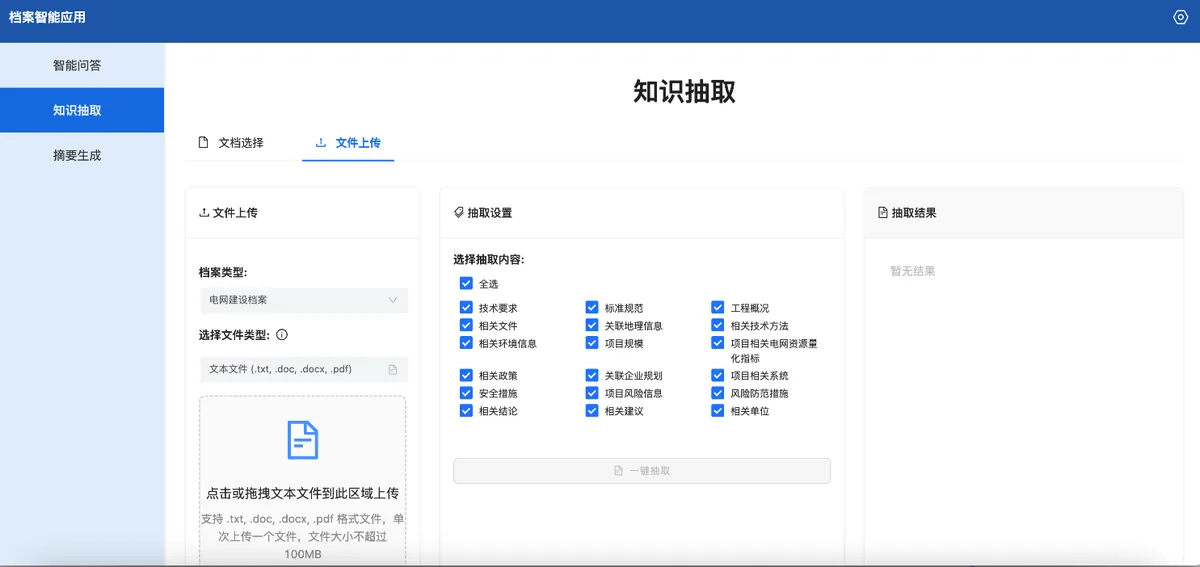
- Extraction templates designed separately for seven archive types (administrative, technical, financial and others), fusing large models, small models and expert rules for both generalisation and accuracy.
- Semantic retrieval and relation mining on top of extraction results, taking retrieval granularity from catalogue down to paragraph.
- AIGC generation of compliant, professional compilations for yearbooks, chronicles, milestone records and organisational history.
- Term-frequency statistics and trend visualisation across time and archive type, supporting development analysis.
Result
- Seven archive types have configurable extraction templates; new types extend by template.
- Retrieval reaches paragraph level and can locate specific wording and its source.
- Four compilation scenarios can be drafted by the system, with human review and sign-off.
This project concerns generative-AI capability build-out for archive data; the above describes capability coverage rather than runtime performance statistics. Any specific performance claim should rely on acceptance material confirmed by both parties.
Put your business in the hands of a trustworthy agent
Book a demo or email us directly — we prepare materials around your industry scenario.