Home/Products/ZhiNet
ZhiNet

ZhiNet · Alert Governance Platform

Ingest · Denoise · Triage · Analyse · Act

Alert governance for monitoring networks: duplicate alerts from the same operation, the same directory or the same business are first clustered and denoised, then triaged by rules and analysed one by one by a large model. Deterministic cases are handled automatically, complex ones wait for human confirmation, and every action is logged and auditable.

Pilot stage (a provincial dispatch centre / a provincial network company)
Who uses it
Security operations, on-duty analysts and auditors
Problem it solves
Alert volume, false positives and hard root-cause tracing
Delivery form
On-premises, connected to existing alert sources and workflows
Interface

One alert, from ingest to action

Each analysis carries a risk grade, a confidence score and its rationale; it states a verdict, then lists actions by rule, and the human only confirms or rejects.
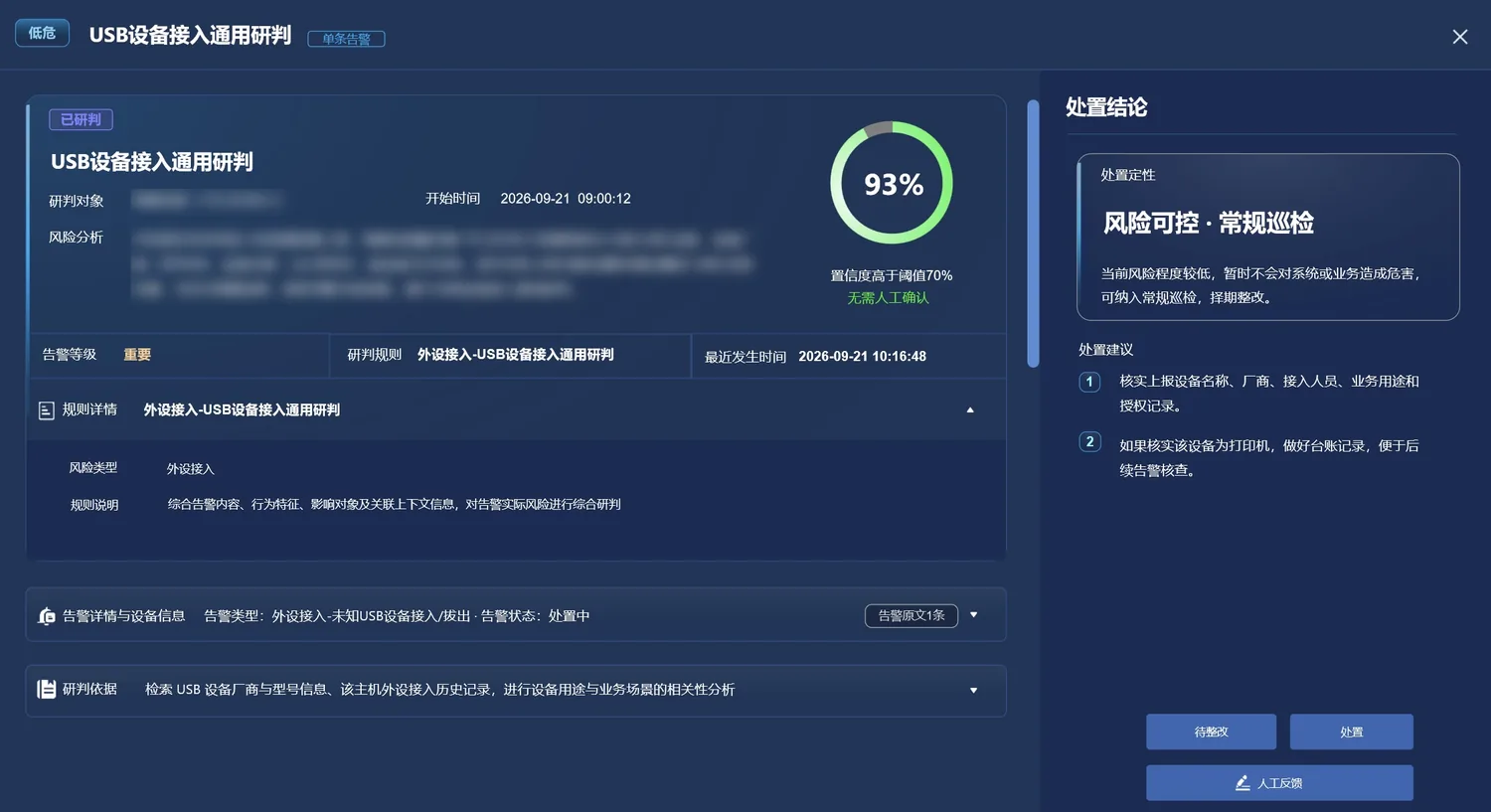
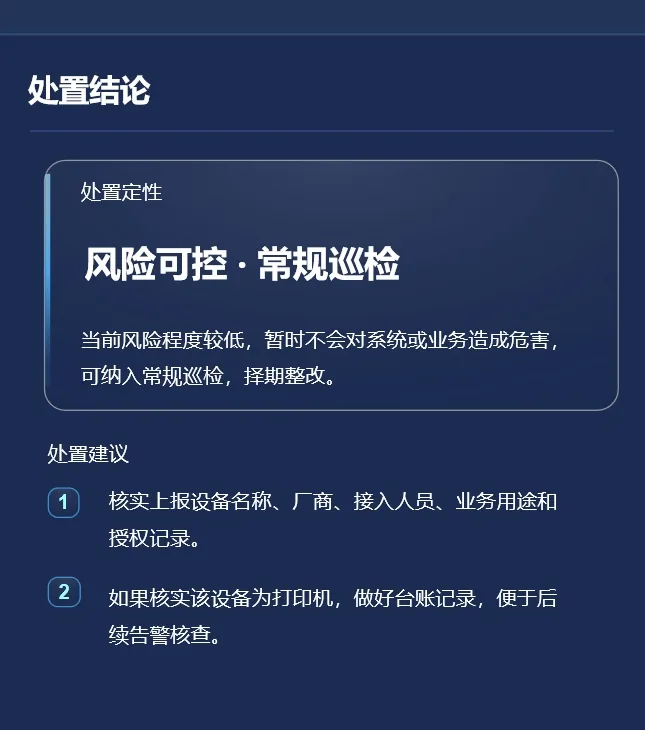
ZhiNet alert analysis: USB device connection analysis and verdict
Alert analysis view (USB peripheral connection): alert details and rationale on the left, verdict and actions on the right
Verdict area: risk under control, routine inspection and two recommended actions

What a verdict looks like

1
A verdict first: risk under control, action required, or false positive — with the reasoning stated.
2
Then the actions: one to three executable verification and remediation steps, by rule.
3
A feedback path stays open: deviations return as rules and samples, and the system keeps iterating.
Pipeline

Six steps

Denoise first, analysis second: compress the duplicates, then let the model focus on real risk.

① Alert ingestConnects to existing monitoring and alert sources and keeps the original alert and device context, with no rewriting.
② Clustering and denoisingDuplicate alerts are clustered by the same operation behaviour, the same directory access or the same business access, compressing useless noise.
③ Rule triageDeterministic rules give a first verdict and a risk grade; obvious false positives are stopped before reaching the model.
④ Model analysisAlert content, behaviour features, affected objects and related context produce the rationale and the recommended actions.
⑤ Human confirmationAbove the confidence threshold, cases pass automatically; below it, or in high-risk scenarios, they go to a human.
⑥ Action executionDeterministic cases are handled automatically, complex ones after confirmation; everything is logged to support security checks and audit.
Result

Pilot figures

The numbers below come from pilot operation at a provincial dispatch centre and a provincial network company, comparing alert volume and work hours during the pilot.

77.2%
Fewer weekly alerts
90.9%
Fewer urgent and important alerts per day
80%
Less manual review time
90%+
Accuracy on high-risk scenarios

After deployment at the provincial dispatch centre, weekly alerts fell from 1,480 to about 336; at the provincial network company, daily urgent and important alerts fell from 565 to 51. Accuracy on high-risk operations, critical directory changes and USB connections exceeded 90%. Pilot figures indicate the order of magnitude and are not a commitment for other deployment environments.

Relation to the platform

PanXing orchestrates and schedules the analysis chain's models; clustering rules and industry experience live in PanZhi and are re-evaluated continuously; platform capabilities pass PanJian admission evaluation before release, and outcomes are written back to existing ticketing and audit flows.

Other products

Put your business in the hands of a trustworthy agent

Book a demo or email us directly — we prepare materials around your industry scenario.

Email us